
Yugoslavia, How Ideology Moved Our Collective Body + Slet 1998 – Double Screening and Q&A with Marta Popivoda | 5 February 2026 | 19:30 | Netherlands Film Academy Amsterdam
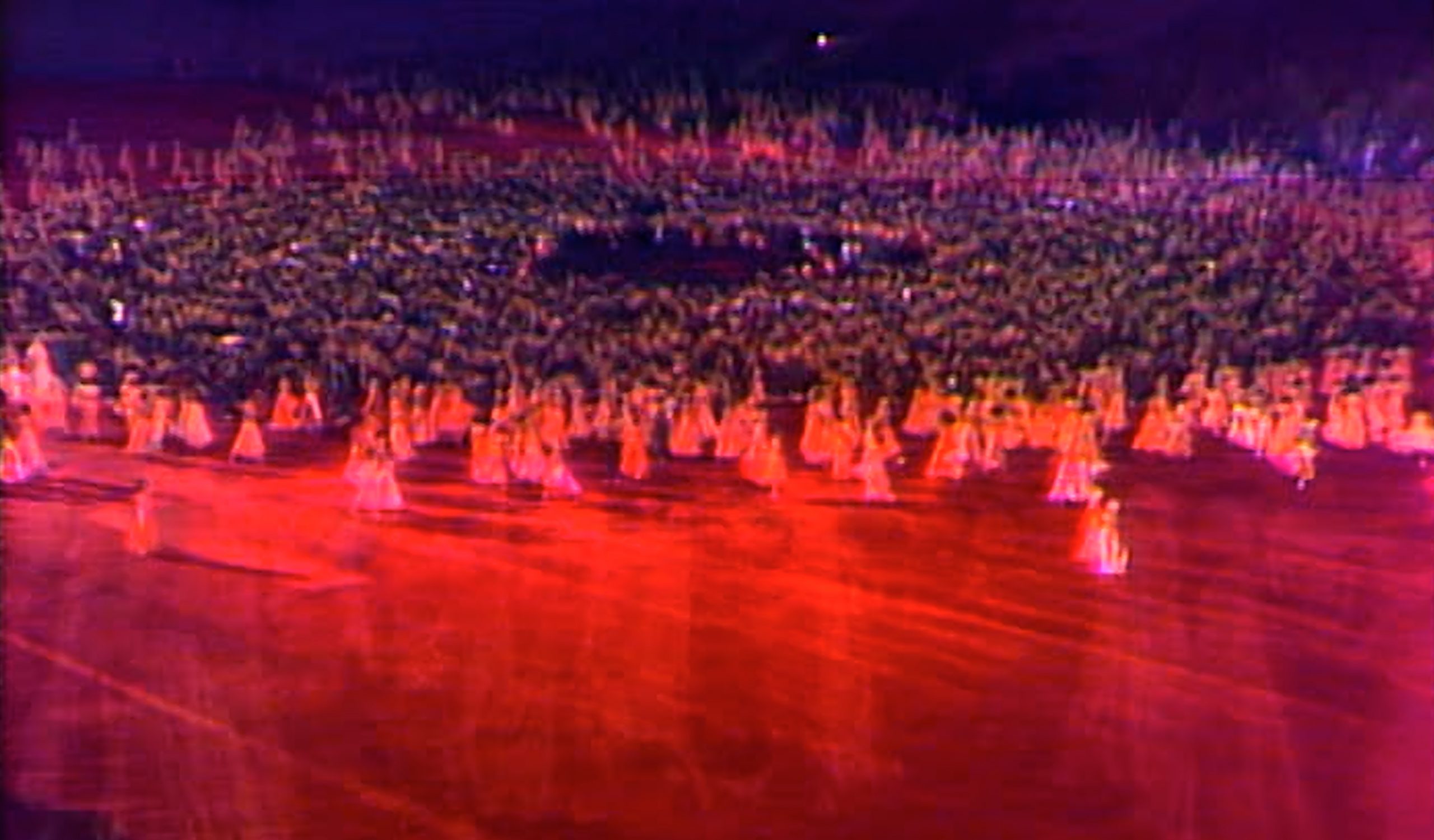
ReCNTR and the Master of Film at the Netherlands Film Academy are happy to present a double screening of Marta Popivoda’s work, followed by a Q&A with film critic Neil Young.
YUGOSLAVIA, HOW IDEOLOGY MOVED OUR COLLECTIVE BODY
2013, 62 min, Serbia / France / Germany
Synopsis. The film explores how ideology performs itself in public space through mass performances. The author collected and analyzed film and video footage from the period of Yugoslavia (1945 – 2000), focusing on state performances (youth work actions, May Day parades, celebrations of the Youth Day, etc.) as well as counter-demonstrations (’68, student and civic demonstrations in the ‘90s, 5th October revolution, etc.). Going back through the images, the film traces how communist ideology was gradually exhausted through the changing relations between the people, ideology, and the state.
Director’s statement. This research-based essay film offers a very personal perspective on the history of socialist Yugoslavia, its dramatic end, and its recent transformation into several democratic nation-states. Experience of the dissolution of the state, and today’s “wild” capitalist reestablishment of the class system in Serbia, are my reasons for going back through the media images and tracing the way one social system changed by performing itself in public space. (Marta Popivoda)
SLET 1988
2025, 22 min, Germany / France / Serbia
Synopsis. In Slet 1988, dancer Sonja Vukićević (74) moves through socialist-modernist spaces; her body is an archive of the last mass performance in Yugoslavia. Her gestures echo past rhythms and present realities, intertwining with a 1988 teenage girl’s diary to reveal the shift from socialist collectivism to rising individualism while a new national collective body is creeping in and will soon shape the future of the country.
Marta Popivoda
Marta Popivoda is a filmmaker, artist, and researcher. The main concerns in her work are the tensions between memory, history, and ideology, as well as the relations between collective and individual bodies. Popivoda approaches them from a feminist and queer perspective. In her recent work, she uses landscape dramaturgy, feminist storytelling, and principles of radical slowness to produce scenes of antifascist and eco-feminist memory. Her work has been presented worldwide in the cinema and visual arts contexts, such as Berlinale, Locarno, IFFR, IDFA, New York Film Festival, Cairo International Film Festival, Visions du Réel, MoMA New York, Tate Modern London, MAXXI Rome, Manifesta Biennial, Berlin Biennale, to name just a few, and featured in the Guardian, Sight & Sound, Screen, Artforum, e-flux, etc. She received several awards for her films and artwork, including the prestigious Berlin Art Prize for the Visual Arts at the Akademie der Künste Berlin. She teaches film at the University of the Arts in Amsterdam and is a member of the European Film Academy. She was a fellow of the Berlin Artistic Research Programme 2024-25.
Neil Young
Neil Young is a film-critic/journalist, curator/programmer, filmmaker and actor from Sunderland (UK), based in Vienna since 2019. His reviews and articles have appeared in The Hollywood Reporter, Screen Daily/International, Sight & Sound, Tribune (London), MUBI Notebook and many other international outlets. Director of the Bradford International Film Festival (UK) 2011-2015, he works for several festivals around Europe in curatorial and/or presentational capacities and has been Head of Selection for the National Competition at the Vienna Shorts film festival since 2019.
Location
Cinema 2nd Floor
Netherlands Film Academy
Markenplein 1, 1011 MV Amsterdam
Netherlands
Date & Time
5 February 2026 | 19:30-22:00
Registration
Please register (for free) here: https://www.filmacademie.ahk.nl/master-of-film-artistic-research/master-of-film-artistic-research-in-and-through-cinema/public-lectures/rsvp-form-lectures/
