
Work-in-Progress Workshop with Visiting PhDs | 17 March | 16:00-18:00 | Leiden [RSVP]
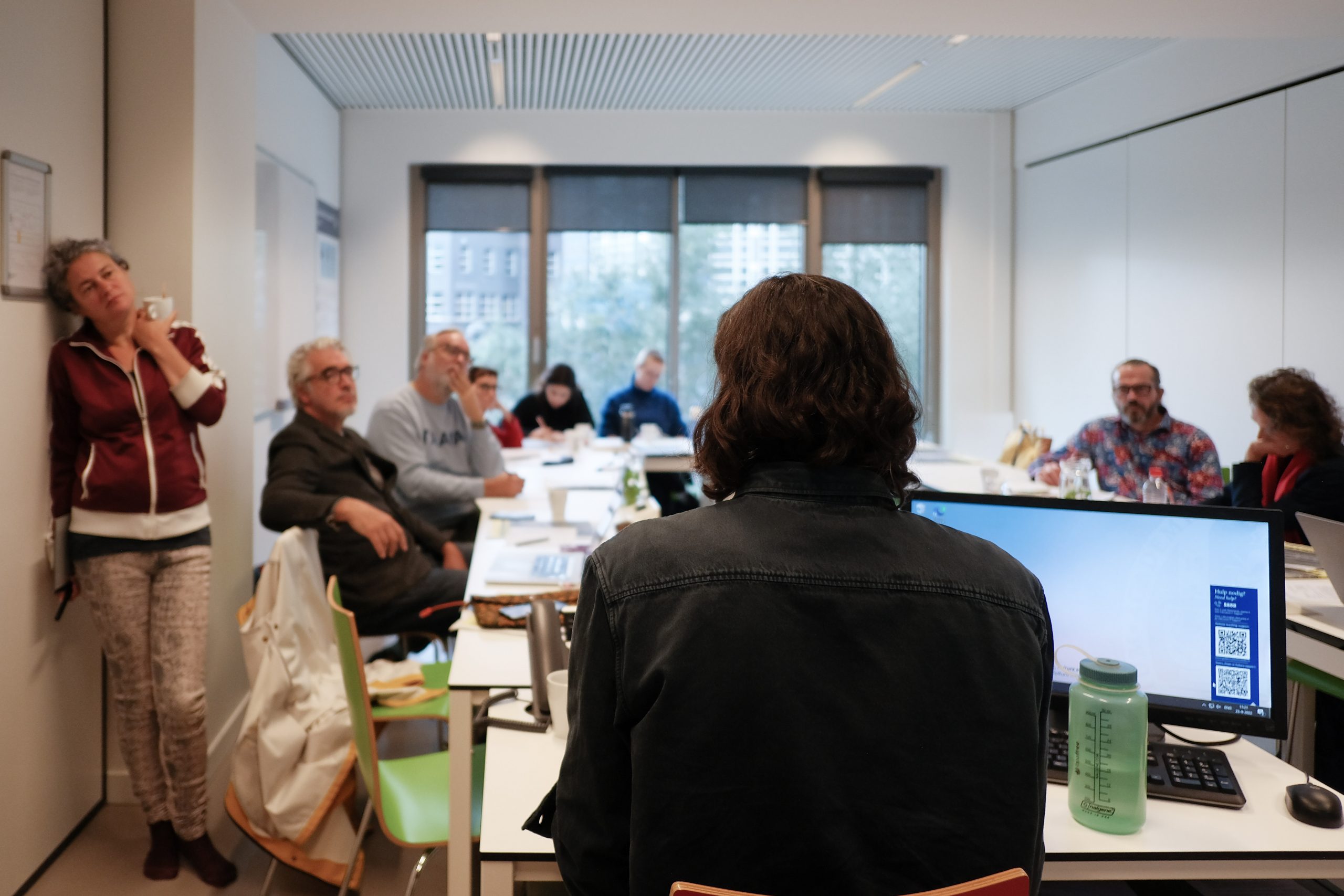
Join us for our next Work-in-Progress Workshop with three visiting doctoral students–Maevia Griffiths, Riccardo Arena, and Carla Alba Pulido–who will each be presenting their ongoing practice-based PhD research. The workshop is free and open to the public (RSVP required) and attendees are invited to provide feedback after each presentation.
Programme:
16.00 – 16.05: WELCOME
16.05 – 16.40: MAEVIA GRIFFITHS (University of Copenhagen)
Practicing Revolutionary Hope:
Reincorporation Spaces of Former FARC-EP Combatants in Colombia – a critical visual inquiry
What becomes of revolutionary hope in the aftermath of armed struggle, and how does it endure or transform through processes of reincorporation? This project explores how different forms of hope persist and transform in the lives of former FARC-EP combatants living in Colombia’s Territorial Spaces for Training and Reincorporation (ETCRs). Rather than treating hope as an emotion, this project approaches it as a political, social and spatial practice that perdures and shifts la lucha (the struggle) beyond demobilisation. In doing so, it contributes to emerging calls within International Relations to move beyond a purely problem-oriented gaze and attend to the practices through which people sustain possibilities for transformation even in contexts shaped by violence and exhaustion. Drawing on the method of documentary filmmaking, the research examines filmmaking not simply as a representational tool but as a sensitive method of inquiry capable of capturing the fleeting moments of hope and everyday textures of post-conflict life – gestures, spaces, and practices through which former combatants sustain visions of the past, present and future for social transformation. Through the cinematic, this project attempts to capture moments of presencing by stepping away from the representational towards the relational in the ‘now’. Through filmmaking storytelling workshops and film reenactments, the method reveals how revolutionary hope transitions through different facets of everyday life, shifting logics of collective struggle toward more individualised trajectories, becoming embedded in infrastructures, social relations, and alternative futures

16.40- 17.15: RICCARDO ARENA (Brera Academy of Fine Arts)
The Zone of Howling Parallels:
Florilegium of Non-Cartographic Representations of Space
This research project investigates non-cartographic modes of spatial representation through an interdisciplinary approach. It originates from the archive Geographical Moments, a personal collection assembled over more than a decade, which gathers spatial practices and environmental knowledge from diverse human and non-human cultures, ranging from mnemotechnics and ephemeral mapping to ritual cosmologies, body inscriptions, and orientation strategies. This material provides the conceptual foundation for rethinking the relations between spatial experience, imagination, and environmental cognition.
The research develops through the artist’s book The Zone of Howling Parallels, composed of visual–textual essays that combine archival sources, historical documentation, and speculative narration. Through this device, this project constructs a dynamic field of inquiry that intersects critical geography, phenomenology, theory fiction, and visual arts, proposing forms of spatial knowledge that exceed the normative paradigm of modern cartography. The title draws on the navigators’ term for the roaring latitudes between the 40th and 60th parallels—where converging winds produce a scream-like sound—and on Leo Lionni’s Botanica Parallela, a speculative taxonomy of fictional vegetal life: essay explores a distinct process of poetic–imaginative spatialization, generating mindscapes understood as configurations in which internal and external landscapes mutually inform one another. Together, they contribute to an expanded aesthetics of space that offers alternative epistemic models for interpreting the interdependency between imagination and the physical environment.

17.15 – 17:50: CARLA ALBA PULIDO (Universidad de Granada / Leiden University)
Mapping memory through the senses in La Vega de Granada
Within the framework of the ‘Etnovegas Collective,’ a multidisciplinary team of 10 people are conducting fieldwork on emotional memory in the municipality of Vegas del Genil. The project being presented is part of this work, which focuses on reflecting sensory memory in relation to landscape, memory, gender roles, and the town’s urban transformations. This map has a dual purpose: to create an interactive map and a “sensory memory” route for residents and visitors.

17.50 – 18.00: CLOSING REMARKS
Bios
Maevia Griffiths is a PhD candidate in Political Sciences at the University of Copenhagen for the ‘Future of humanitarian Design – HUD’ project. Merging filmmaking and social science research, she holds dual Masters in Documentary Filmmaking (Goldsmiths University of London, 2022) and Development Studies (Geneva Graduate Institute, 2021). Her transdisciplinary approach mobilises visual methods to address social (in)visibilities, violence prevention, memory and human rights.
Riccardo Arena (1979, Milan) is an artist, teacher, and researcher. His practice is dedicated to crafting evocative environments that, by combining conceptual and visual research, are conceived as cultural devices for imaginative knowledge. Installations, films, narratives, and workshops intertwine in a constellation of expressive languages aimed at contemplating, within the accidental, the universal
components that bind stories, cultures, and myths across distant times and geographies.
After developing long-term projects in China (Four Times a Tree, 2006–2008), Argentina (Ellero’s Dual Death and the Visual Ecosystem, 2009–2012), Russia (Vavilon, 2013–2017), and LuDD! – Topography of Light (2017–2020), inspired by a series of journeys through Iran, Armenia, and Ethiopia, since 2022 he has been engaged in Geranos, a research trajectory involving the cultural histories of Monte Verità and the Eranos Foundation, the Anthropological Museum of Mexico City, and the Warburg Institute archives. He is currently pursuing a PhD in Artistic Research at the Brera Academy of Fine Arts.
Carla Alba Pulido is an anthropologist specializing in sensory and multimodal ethnography. She holds a Bachelor’s degree in Fine Arts (University of Barcelona), a Master’s degree in Psychopedagogy (UNIR), and a Bachelor’s degree in Social and Cultural Anthropology (University of Granada). She is currently pursuing her doctorate with an FPU grant from the Spanish Ministry of Science, Innovation and Universities and is a teacher in the Department of Anthropology at the University of Granada. Her thesis is titled “Production, Dissemination, and Multimodal Transfer of Knowledge in the Social Sciences: An Anthropological Perspective.” She has conducted various projects focusing on rural areas, memory, and gender roles, primarily through audiovisual anthropology. She is currently completing her PhD stay at the Institute of Cultural Anthropology and Development Sociology at Leiden University.
When and Where:
Date: 17 March, 2026 (Tuesday)
Time: 16:00 – 18:00
Location: Agora (formerly Pieter de la Court) Building | Room 0B.06
Wassenaarseweg 52, Leiden
Everyone is welcome to attend and provide feedback (please use the RSVP form below).
To present your work at future work-in-progress sessions hosted by ReCNTR, pleas e-mail us at recntr@fsw.leidenuniv.nl with “Presentation Work-in-Progress” in the subject line, and mention your (ongoing) project title + a short description + bio in the e-mail.
